
Reviewed · FOOD & DRINK
Half-Day Famous Georgian Supra Feast
A Georgian supra is not simply dinner. It is a social ceremony built around food, toasts, music, and a toastmaster who keeps the evening moving. This four-hour experience combines an old Tbilisi walk with cooking lessons and a family feast, so you get both city context and a seat at the table.
I especially like the hands-on khinkali and khachapuri class, and the chance to learn how a Georgian tamada leads the toasts and uses a drinking horn. The views from the family home, homemade wine, dancing, and polyphonic singing add real character. The main caution is language: one evening leaned heavily toward Russian, with only limited English translation, despite English being the advertised language.
Key points to know
- A small-group Georgian feast: The advertised maximum is eight people, creating a more personal setting than a large dinner show.
- Cooking before eating: You make khinkali and khachapuri before sitting down to a full supra.
- Old Tbilisi comes first: The walk includes Meidan Bazaar, Metekhi Cathedral, Rike Park, and the Holy Trinity Cathedral.
- Wine and chacha are included: Homemade drinks accompany the meal, with lessons in Georgian toasting.
- Music is part of the meal: Professional dancers teach basic movements, and Georgian polyphony is performed.
- English may vary by evening: A translator was arranged successfully for one group, but another received only limited English translation.
Why a Georgian supra is more than a meal
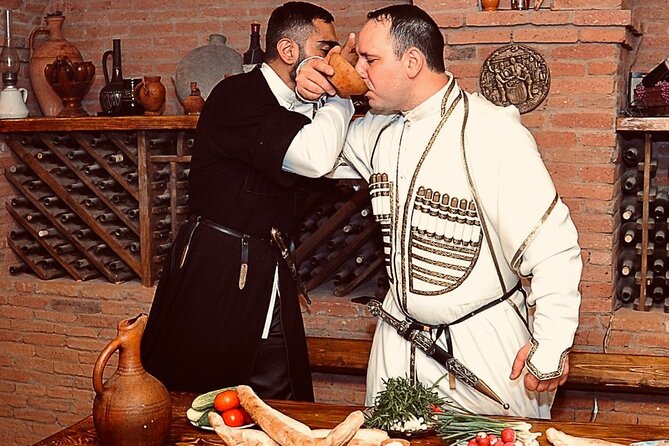
The heart of this outing is the supra, Georgia’s great shared feast. Food arrives in generous waves, but the real structure comes from the toasts. A tamada, or toastmaster, guides the table through a sequence of subjects, from friendship and family to the country itself.
You are not expected to sit quietly and watch. You will be shown how the feast works, how to drink from a horn, and how to join the atmosphere without needing to know every Georgian custom in advance. That makes this a useful choice if you want more than a restaurant dinner.
I like that the meal follows a cooking lesson. You handle the food first, then understand it better when it reaches the table. Khinkali are Georgian soup dumplings, while khachapuri is cheese-filled bread. Making both gives you a practical look at two foods you are likely to encounter all across Georgia.
The evening also has a strong social side. The host works to connect people at the table, and one English-speaking group was given an English translator who handled both the language and the cultural explanations well. That kind of help matters during a toast-heavy meal, where much of the meaning can otherwise pass you by.
More food tours in Tbilisi:
- Day Trip to Kakheti Wine Region Including 9 Wine Tastings
★ 5.0 · 2,774 reviews - Kakheti Wine Region: Signagi and Bodbe Tour with 10 Wine Tastings
★ 5.0 · 1,019 reviews - Tbilisi:Mtskheta,Jvari,Bazaar,wine tasting,Chronicles of Georgia
★ 5.0 · 730 reviews
Old Tbilisi begins at Meidan Bazaar
The tour starts at the I Love Tbilisi sign at 5:30 pm. From there, the walk moves through central Tbilisi, beginning with Meidan Bazaar.
Meidan is a useful place to start because it puts you close to the old city’s lanes, shops, and traditional meeting points. The guide uses the walk to explain Georgian history, legends, and customs. This is not a long sightseeing tour with time to enter every monument. Think of it as a compact introduction before the food takes over.
For you, the main benefit is orientation. Tbilisi can feel like a jumble of old stone streets, balconies, churches, hills, and modern spaces. A guide can connect these pieces and explain how the city’s traditions fit together.
The walk also sets the tone for the rest of the evening. You begin with the public face of Tbilisi, then move toward the private, family-based hospitality that defines the supra.
Metekhi Cathedral and the river views
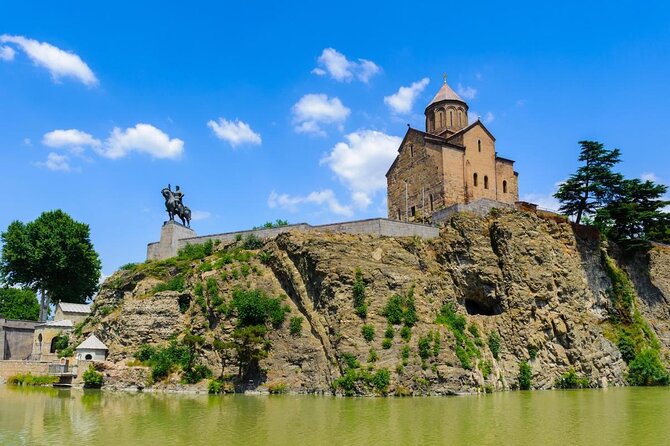
Metekhi Cathedral is the next listed stop. Perched above the Mtkvari River, it is one of Tbilisi’s most recognizable religious sites and one of the city’s best-known viewpoints.
The stop gives you a chance to see how the city is shaped by the river and its hills. It also brings Georgian religious tradition into the evening before you sit down to eat. The guide discusses history and local customs during the walk, so the cathedral is part of a broader cultural explanation rather than an isolated photo stop.
Keep your expectations practical. This is a short walking section within a four-hour experience, not a full church tour with extensive interior time. If your main goal is museum visits or detailed architectural study, you will need a separate Tbilisi sightseeing tour.
Rike Park adds a modern contrast
Rike Park provides a change of mood. Located beside the river, it is a newer public space with open views and a modern urban feel.
Including Rike Park helps show that Tbilisi is not only an old town of churches and narrow streets. The route shifts between historic and newer parts of the capital, giving you a more rounded first look at the city.
The walk is also a practical way to build an appetite before dinner. You will want comfortable shoes, since the experience begins on foot before private transport takes you to the family home. The supplied details do not specify the exact walking distance, so anyone with mobility concerns should ask the provider before booking.
A few more Tbilisi days to weigh up
- Ancient Mtskheta and Chronicle of Georgia half day tour
★ 5.0 · 66 reviews - Half-Day Food Tour of Tbilisi Dezerter’s Bazaar
★ 5.0 · 4 reviews - Jvari monastery & Mtskheta – Half day group tour from Tbilisi
★ 5.0 · 3 reviews
Holy Trinity Cathedral closes the city walk
The Tbilisi Holy Trinity Cathedral, often called Sameba, is the final listed stop before the food portion. Its large scale makes it an impressive counterpoint to the older streets around Meidan.
Here, the focus is again on Georgian religious life, history, and tradition. The cathedral helps explain why faith and ceremony carry such weight in Georgian culture, including at the supra, where toasts often touch on family, friendship, memory, and national identity.
The sequence of stops is well chosen for a short introduction. You see an old market area, a historic cathedral above the river, a modern park, and a major religious landmark. You will not see every important corner of Tbilisi, but you do get a useful sample before dinner.
Cooking khinkali and khachapuri with the family

After the city walk, private transportation takes you to a Georgian family of hereditary winemakers and cooks. The home setting is a major part of the appeal. Instead of meeting a restaurant kitchen team, you are welcomed into a family environment connected to wine and food traditions.
While the hosts prepare the class, you can look around the property and take photographs. The setting is described as having especially fine views, which gives you something to do before cooking begins and adds a scenic element to the evening.
The class focuses on khinkali and khachapuri. You will learn the basics of preparing Georgian dumplings and bread, then later eat them as part of the feast. The lesson is meant to be fun and approachable rather than a professional cooking course.
Khinkali can be filled with meat, mushrooms, or cheese. The menu does not promise that every filling will be available at every sitting, so you should ask if you have dietary concerns. Khachapuri is served Adjarian style, with dough, cheese, and egg, and arrives hot.
I like this part because it gives you something to do with your hands. A standard food tour may explain dishes and let you taste them. Here, you also see the work behind them, which makes the final meal more satisfying.
The supra table: what you will eat

The meal is generous and designed for sharing. It includes several cold starters, hot dishes, meat, cheese, and a traditional sweet.
You can expect:
- Georgian salad with cucumbers, tomatoes, and herbs
- Pickled cucumbers and tomatoes
- Sauerkraut and Colchis klekachka
- Khinkali with meat, mushrooms, or cheese
- Aubergine
- Adjarian khachapuri
- Mtsvadi, Georgian meat cooked on skewers over coals
- Imeretian cheese
- Churchkhela, made from grape juice and walnuts
This is not a light tasting menu. The combination of bread, dumplings, grilled meat, cheese, and pickles makes the meal substantial. Pace yourself early, especially if you want to try every dish and still have room for churchkhela.
The menu also offers a good introduction to the balance of Georgian food. Fresh herbs and salad cut through heavier dishes. Pickles add sharpness. Bread and cheese provide the comfort-food base, while mtsvadi brings smoke and grilled meat to the table.
Dinner, alcoholic drinks, coffee or tea, and private transportation are included in the price. Breakfast is not included, though that should not matter for a 5:30 pm start.
Wine, chacha, and the rules of the toast

Homemade wine and chacha are part of the evening. Chacha is a strong Georgian grape spirit, so you should treat it with care, even in a festive setting.
The host explains how the Georgian feast works and guides you through the order of toasts. You will also learn how to drink from a horn. These details are not just decoration. They help you understand why a supra can last for hours and why the toastmaster has such an important role.
The phrase unlimited wine appears in one account of the evening, while the formal inclusions specify alcoholic beverages. If the amount or type of alcohol matters to you, confirm the arrangement before booking. Either way, you should not feel pressure to drink. The value of the experience is in the ritual and conversation, not in consuming as much as possible.
This part will suit you if you enjoy shared meals and cultural customs. It may be less comfortable if you prefer a quiet dinner with a fixed menu and little interaction.
Dancing and Georgian polyphony after dinner

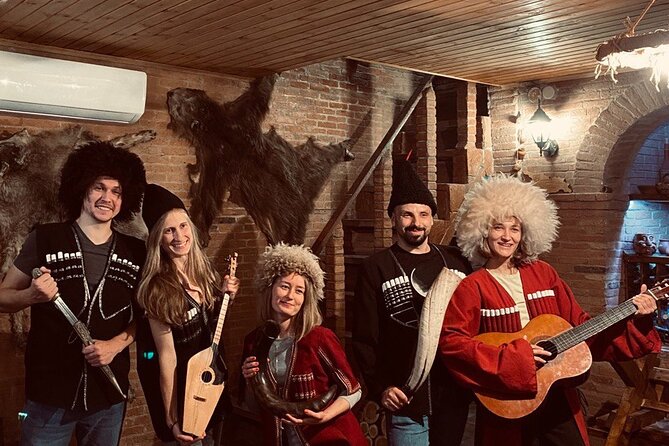
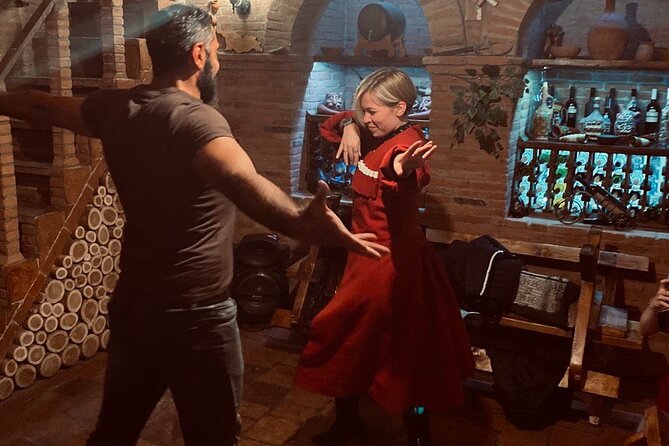
The meal continues with dance and song. Professional dancers teach basic Georgian dance movements, so you can take part rather than simply watch.
The dancing is an important change of pace after a long meal. It keeps the evening social and gives the group a simple activity that does not depend entirely on conversation. You do not need dance experience, since the lesson covers basic movements.
You will also hear Georgian polyphonic singing. Georgian polyphony is listed by UNESCO as part of the country’s intangible cultural heritage. Hearing it within a family feast makes the music feel connected to daily culture, rather than presented as a separate stage performance.
The balance here is worth noting. This is a cultural dinner with entertainment, but it is not described as a formal concert or professional dance production. The emphasis is participation, atmosphere, and tradition.
Language, group size, and the evening’s mood
The experience is offered in English and has a maximum of eight people. A small group should make it easier to ask questions, take part in cooking, and speak with the host.
Still, language arrangements may not be identical every night. An English-speaking group had an excellent translator who explained Georgian culture and history clearly. On another evening, the event was conducted mainly in Russian because most of the group spoke Russian, with only limited English interpretation.
That is the clearest practical caution in the available information. If you need detailed English explanations throughout the evening, contact Georgian Promenade before booking and ask how translation will be handled for your date.
The small-group limit helps, but it does not guarantee that every person at the table will speak the same language. You should book this for its food, hospitality, and cultural setting, while treating the language arrangement as something to confirm.
Is $150 a fair price?
At $150 per person, this is not a budget dinner. You are paying for several parts at once: a guided old Tbilisi walk, private transportation, a cooking lesson, a large dinner, alcoholic drinks, coffee or tea, music, dancing, and a family-hosted setting.
The value depends on what you would otherwise book separately. If you only want khinkali and wine, a local restaurant will cost much less. If you want a private food experience, transportation, cultural explanations, and entertainment in one evening, the price becomes easier to justify.
The current score is 4.9 from 13 ratings, with 100 percent recommending the experience. That is a small sample, so I would not treat the number as a guarantee. The strongest reasons to pay the premium are the personal setting, the cooking class, and the chance to learn the customs of a supra from a host rather than from a menu.
Who should book this Georgian evening?
I would recommend it most to first-time visitors who want an easy introduction to Georgian food and hospitality. It also suits couples, small groups, and solo visitors who enjoy meeting people around a shared table.
Food lovers will appreciate the practical class and wide menu. Culture-focused visitors will enjoy the toastmaster, drinking horn, folk dance, and polyphonic music. The private transport is useful because you do not have to arrange your own way between the city walk and the family home.
I would be more cautious if you dislike group participation, alcohol-centered customs, or uncertain language arrangements. It may also be a poor fit if you want a detailed tour inside each cathedral or a quiet fine-dining meal.
The experience ends back at the original meeting point. Free cancellation is available if you cancel at least 24 hours before the 5:30 pm start time. Changes or cancellations inside that period are not accepted for a refund.
Should you book the supra feast?
Book it if you want one evening that combines Tbilisi sights, cooking, a serious amount of food, wine, toasts, dance, and music. The family setting and cooking lesson give the night more substance than a simple dinner show.
Before paying, confirm the English translation for your date, especially if you do not speak Russian. If that point is settled, the $150 price can be fair for a four-hour private-style cultural experience with transport and drinks included. If your priority is low cost or a quiet meal, choose a restaurant instead.
FAQ
Where does the experience start?
It starts at the I Love Tbilisi sign in Tbilisi, Georgia.
What time does the tour begin?
The start time is 5:30 pm.
How long does the experience last?
It lasts approximately four hours.
Where does the experience end?
It ends back at the original meeting point.
How many people can join?
The activity has a maximum of eight people.
Is the experience offered in English?
English is listed as an available language. Translation arrangements can vary, so confirm the English support for your date.
What food is included?
The menu includes Georgian salad, pickles, khinkali, aubergine, Adjarian khachapuri, mtsvadi, Imeretian cheese, and churchkhela.
Are drinks included?
Yes. Alcoholic beverages, including homemade wine and chacha, are included. Coffee and tea are also included.
Is transportation included?
Yes. Private transportation is included.
Can I cancel for a full refund?
Yes, if you cancel at least 24 hours before the experience start time. Cancellations or changes made less than 24 hours before the start are not accepted for a refund.
Just added around Tbilisi
- Old tbilisi walking tour & wine tasting★ 5.0 · 9 reviews
- Tbilisi Airport to Gudauri, Bakuriani, Batumi, Tbilisi★ 5.0 · 3 reviews
- Private Adorable City Tour of Tbilisi★ 5.0 · 3 reviews
- Vardzia. Lake Paravani, Khertvisi & Lomisa castle, Rabati★ 4.5 · 12 reviews
- full day Kazbegi-Gudauri-jvari -from Tbilisi★ 5.0 · 6 reviews
- Your unique photo session in Tblisi, Georgia★ 3.5 · 4 reviews
- Private Wine Tour In Kakheti Region with 7 Wines and Lunch★ 5.0 · 3 reviews
- Wine promenade in hospitable Tbilisi★ 5.0 · 17 reviews
Food & Drink, compared.
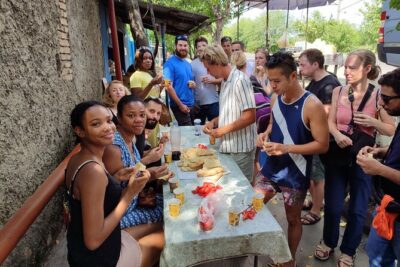
Day Trip to Kakheti Wine Region Including 9 Wine Tastings
Read our review →
Kakheti Wine Region: Signagi and Bodbe Tour with 10 Wine Tastings
Read our review →
Mtskheta,Jvari,Bazaar,wine tasting,Chronicles of Georgia
Read our review →
Old Tbilisi Highlights walking tour with wine & 10 tastings
Read our review →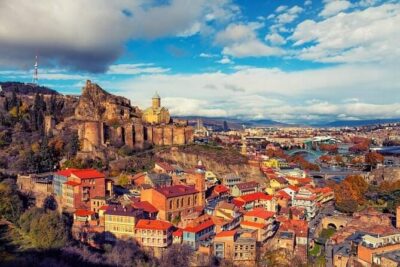
Old Tbilisi Tour: Private Walking Tour With Wine Tasting
Read our review →
Private Tbilisi Food Tour: 9 Tastings Walk in Bohemian District
Read our review →
Full Day Private Wine Tour in Kakheti Region with Lunch and 3 Wine Tastings
Read our review →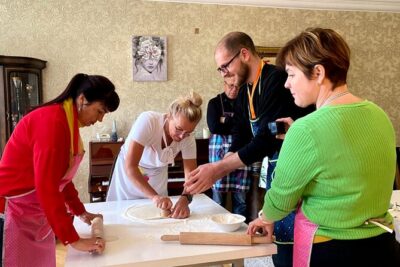
Browse the lists this tour appears in