
Reviewed · WINE TOURS
Old Tbilisi Tour: Private Walking Tour With Wine Tasting
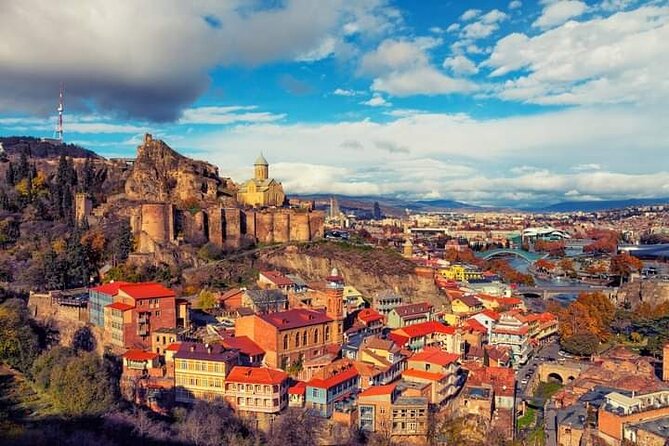
Old Tbilisi comes alive when you see it in one sweep: fortress walls above you, sulfur baths below, church domes around the corner, and the Mtkvari River cutting through it all. This private walk combines the city’s key sights with a cable-car ride to Narikala Fortress and a Georgian wine tasting, so you get both the broad view and the close-up details.
I like the flexible pace and the way the route links major sights without feeling like a parade from one photo stop to the next. I also like the personal touch of guides such as Luka, Lela, Mirian, Mariam, and Khatia, who are praised for clear explanations, friendly conversation, and useful food suggestions. The main drawback is physical: steep streets, stairs, and uneven paving make this a better choice for people with moderate fitness than for anyone seeking a gentle, seated tour.
Key points to know before booking
- The cable car gives you the best opening view: Ride up toward Narikala Fortress, then look across central Tbilisi and down toward the Botanical Garden.
- This is a private walk: Only your group takes part, so your guide can adjust the pace and explain the subjects that interest you most.
- The route covers Old Tbilisi’s main sights: Expect a compact circuit of fortress walls, sulfur baths, a waterfall, churches, the Peace Bridge, and riverside views.
- Wine is part of the cultural lesson: The tasting offers an easy introduction to Georgia’s long wine tradition, not just a drink at the end.
- Timing matters in summer: Morning or evening is more comfortable, and one guide recommends around 7:30 p.m. for a cooler cable-car ride and softer light.
- The meeting point is beside Metekhi Church: The tour ends back at the same meeting point, with hotel pickup and drop-off not included.
Why this private Old Tbilisi walk works so well

At $39 per person, this tour offers good value if you want a guide’s context rather than a simple sightseeing stroll. The price includes the guide, cable-car ticket, and wine tasting. You are not paying for transport around the whole city, but you are getting a focused route through the historic center with a private guide.
The private format is the biggest advantage. If you want more detail about Georgian Orthodox Christianity, Soviet-era Tbilisi, local food, or wine, you can steer the conversation. If you prefer a lighter overview, guides have shown they can keep the pace relaxed and avoid turning two and a half hours into a lecture.
The tour is offered in English. It usually lasts two to three hours, although the exact length can depend on your pace, questions, and how smoothly the cable car is operating. It is also popular enough to be booked about 19 days ahead on average, so I would reserve early if your dates are fixed.
More Tbilisi wine days worth an afternoon:
- Day Trip to Kakheti Wine Region Including 9 Wine Tastings
★ 5.0 · 2,774 reviews - Kakheti Wine Region: Signagi and Bodbe Tour with 10 Wine Tastings
★ 5.0 · 1,019 reviews - Tbilisi:Mtskheta,Jvari,Bazaar,wine tasting,Chronicles of Georgia
★ 5.0 · 730 reviews
Beginning at Metekhi and rising to Narikala
The meeting point is Metekhi Church of the Nativity of the Mother of God, on Metekhi Street. This is a useful place to begin because you are already close to the river, the old center, and the route back through Rike Park.
The first major move is the cable car up toward Narikala Fortress. The ride saves you a long uphill climb and gives you an instant sense of Tbilisi’s shape. You can see the Mtkvari River, the tightly packed old neighborhoods, and the hills that frame the capital.
At Narikala, you walk around the remaining fortifications and hear how the site changed over time. The stronghold began in the fourth century as a Sasanian citadel called Shuris-tsikhe, later expanded under the Umayyads, and was enlarged again during the reign of David the Builder. The Mongols gave it the name Narin Qala, meaning Little Fortress.
Much of what remains dates from the 16th and 17th centuries. An earthquake in 1827 damaged parts of the complex, and some sections were later demolished. Do not expect a fully restored castle with rooms to explore. The appeal is the setting, the walls, and the wide view.
One of the nicest details here is the contrast on either side of the fortress. One direction looks over a busy capital, while the other opens toward the quiet greenery of the Botanical Garden. That quick shift from city to trees helps you understand why Tbilisi feels both urban and close to nature.
The fortress stop is planned for about 20 minutes. That is enough for a look around and photographs, but not enough for a long archaeological exploration.
Kartlis Deda and the meaning behind the statue
A short visit to Kartlis Deda, or Mother of Georgia, adds a piece of modern Georgian symbolism to the older fortress setting. The 20-meter aluminum statue was erected on Sololaki Hill in 1958, when Tbilisi marked its 1,500th anniversary.
The woman holds a bowl of wine in her left hand and a sword in her right. The image is direct and memorable: friends are welcomed with hospitality, while enemies are met with strength. It is also a useful introduction to a theme you will see throughout Georgia, where wine and welcome are closely tied to national identity.
This stop lasts about 10 minutes. The statue itself does not require much time, but the guide’s explanation gives it meaning beyond a quick photograph.
Walking down through Abanotubani
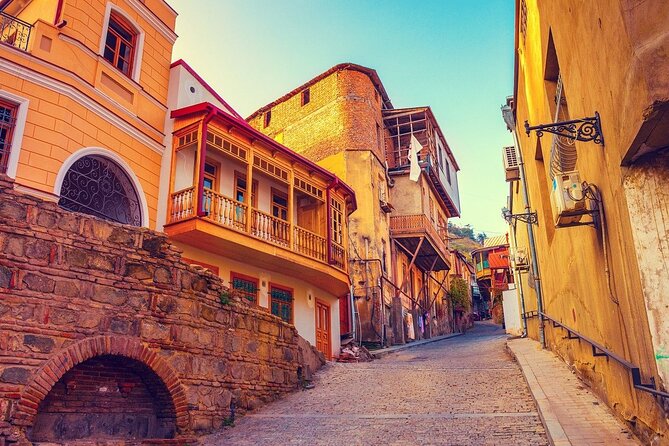
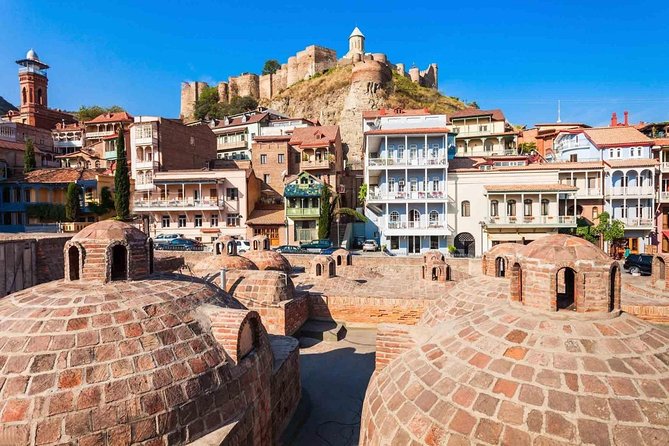
From the fortress, the route heads downhill toward Abanotubani, Tbilisi’s sulfur-bath district. This is one of the city’s defining areas, and it is where the name Tbilisi is linked to the Georgian word for warm.
Sulfur water rises naturally here, with an average temperature of about 47 degrees Celsius. The area supplies roughly 3 million liters of water each day. Even if you are not planning to use a bath, the domed roofs and warm-water tradition help explain why this valley became the setting for the city.
The guide can also tell you the founding legend. According to the story, King Vakhtang Gorgasali discovered the hot springs in the fifth century, helping lead to the creation of Tbilisi. As with many old city legends, the story blends memory, symbolism, and history, which makes it especially useful when explained on site.
You spend about 20 minutes here. The district is atmospheric, but the streets can be uneven and the route continues downhill, so wear shoes with a firm sole.
More food tours in Tbilisi:
- Old Tbilisi Highlights walking tour with wine & 10 tastings
★ 5.0 · 276 reviews - Private Tbilisi Food Tour: 9 Tastings Walk in Bohemian District
★ 5.0 · 227 reviews - Full Day Private Wine Tour in Kakheti Region with Lunch and 3 Wine Tastings
★ 5.0 · 207 reviews - Tbilisi Food Tour in a Local Family
★ 5.0 · 113 reviews
A cool pause at Legvachtahvi Gorge
Legvachtahvi Gorge brings a surprising change of mood. Just a short walk from the sulfur baths, you reach a small waterfall tucked into the old city.
The path is accessible and follows the gorge through the center of Tbilisi. In summer, the shade and falling water offer a welcome break from the heat. It is not a giant waterfall, so keep your expectations sensible. Its charm comes from the setting: a compact natural spot surrounded by the city.
The stop lasts about 10 minutes. It is a good place to slow down, take photographs, and notice how quickly Tbilisi shifts from stone streets to a narrow green ravine.
Jan Shardeni Street and the modern old town

After the gorge, the walk continues toward Jan Shardeni Street, often called Chardin Street. It is named for Jean Chardin, the French traveler who visited Georgia in the 18th century.
This street is one of the more social parts of Old Tbilisi, with restaurants, cafés, and nightlife. The area can stay active until the early morning, reportedly as late as 5 a.m. That makes it useful for orientation if you plan to return later for dinner or drinks.
This is also where a private guide can add value by separating the old city’s genuine character from its more polished visitor areas. The street is attractive and convenient, but it is not the quietest or most traditional section of the route.
Sioni Cathedral and the city’s religious core
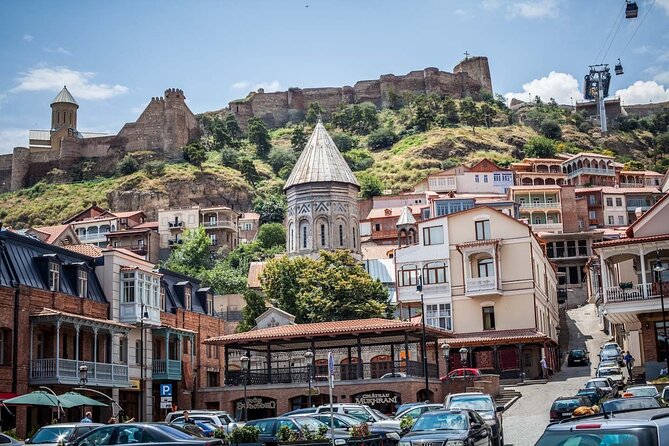
Sioni Cathedral provides a more serious pause. The site has held a church since the fifth century, when one was ordered by Vakhtang Gorgasali. The present building dates mainly from the 17th century.
Inside, the cathedral preserves the original cross associated with St. Nino, a central figure in Georgia’s Christian tradition. The guide can explain why the church matters without requiring you to know the details in advance.
Plan on about 10 minutes here. Dress and behave respectfully, as this is an active religious place rather than simply a monument. Depending on services or access at the time, the visit may focus more on the exterior and surrounding square.
Crossing the Bridge of Peace

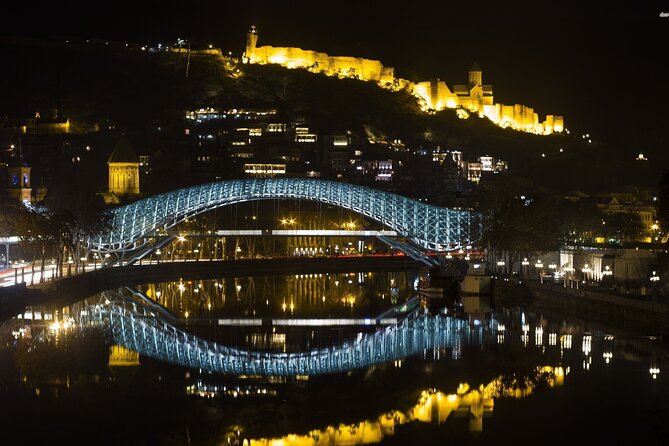
The Bridge of Peace is Tbilisi’s modern counterpoint to its fortress, baths, and churches. Opened in 2010, the glass-and-steel pedestrian bridge stretches 156 meters across the Mtkvari River and uses about 10,000 lamps.
It is often photographed from the riverbanks, but walking across gives you a better sense of its shape and position. The bridge connects the old center with Rike Park and helps show how Tbilisi has added new public spaces beside its historic core.
The stop is listed at around 20 minutes. That gives you time for the crossing, views along the river, and photographs. Some people love the futuristic design, while others find it jarring beside the older buildings. I consider that contrast part of the point. Tbilisi is not a preserved museum city. It is a living capital with several eras sharing the same few blocks.
Metekhi Cathedral and the return to the river
The final major stop is Metekhi Cathedral, located on the left bank of the Mtkvari. You return through Rike Park before reaching the church and its courtyard.
The site is linked by tradition to St. Shushanik, whose remains are said to be here. The courtyard also holds a statue of Vakhtang Gorgasali, the king connected with the founding story of Tbilisi.
Metekhi is a fitting end because it brings the tour back to the starting area. You have seen the city from above, crossed its central river, and walked through the neighborhoods that grew around its churches and hot springs.
The activity ends at the original meeting point. Since hotel pickup and drop-off are not included, you will need to arrange your own way to Metekhi Church before the start and continue independently afterward.
The wine tasting is more than a final drink
The wine tasting adds a strong cultural reason to choose this tour over a basic walking route. Georgia is closely associated with wine production, and tasting local varieties gives you a direct way to connect the city tour with the country beyond Tbilisi.
The tasting is included in the price. The exact venue and selection can vary, but the experience has been described as a relaxed stop with excellent samples, and some sessions have included chacha. One group even returned afterward to buy a bottle and enjoy it on a rooftop patio.
Do not book this expecting a formal vineyard visit or a full winery seminar. The tour remains a city walk. Think of the tasting as a friendly introduction and a chance to ask questions about Georgian wine, food, and local customs.
Guides also offer practical suggestions for places to eat. Luka, in particular, is praised for recommending good Georgian food at reasonable prices. That kind of advice can save you from choosing a restaurant at random on your first night.
Which guide and pace should you request?
The guide assigned to you is not guaranteed, but several names are associated with strong feedback: Luka, Lela, Mirian, Mariam, and Khatia.
Luka is described as friendly, flexible, and good at balancing detail with a moving route. He has also been praised for adjusting his style to the group and for making the wine tasting a memorable part of the afternoon.
Lela is known for warm storytelling and for adding extra places when time and interest allow. Mirian is noted for a relaxed manner and broad knowledge. Mariam has given useful timing advice, including taking the cable car around 7:30 p.m. in summer.
If you have a preference, ask when booking, but treat it as a request rather than a promise. The more important point is that this private format allows the guide to adapt. Previous guests have had the schedule adjusted when the cable car was closed, with the route rearranged rather than simply abandoned.
Practical planning for a two to three hour walk
Wear comfortable shoes. The tour includes hills, downhill walking, uneven streets, and several stops where you will be standing. A moderate level of fitness is advised.
Summer heat is the main timing concern. Morning or evening is more comfortable than the middle of the day. Around 7:30 p.m. can offer a cooler ride and pleasant city views, but check the selected start time when booking.
The tour requires good weather. If poor conditions cause cancellation, you can choose another date or receive a full refund. You can also cancel for a full refund up to 24 hours before the start time. Changes or cancellations made within 24 hours are not refunded or accepted.
Service animals are allowed, and the meeting point is near public transportation. The tour is private, so group discounts may make the $39 price even better for several people sharing the experience.
Should you book the Old Tbilisi private tour?
Book it if you want a compact first look at Tbilisi with a guide who can explain what you are seeing and adjust the pace to your interests. It is especially useful early in a stay, since you will learn where the old center is, understand the major sights, and collect food and evening suggestions for later.
The tour is less suitable if you want a long visit inside each church, a detailed fortress excavation, or a slow food tour. The schedule covers a lot in two to three hours, so most stops are introductions rather than extended visits.
For $39, the private guide, cable-car ticket, city views, major Old Tbilisi sights, and wine tasting make this a sensible choice for first-time visitors. I would book it for the first or second day of a Tbilisi stay, choose a cooler time of day, and arrive ready to walk.
FAQ
How much does the Old Tbilisi private walking tour cost?
The listed price is $39 per person. Group discounts may be available.
How long does the tour last?
The tour lasts approximately two to three hours.
Is the tour private?
Yes. Only your group participates in the activity.
What language is the tour offered in?
The tour is offered in English.
Where does the tour start?
It starts at Metekhi Church of the Nativity of the Mother of God on Metekhi Street in Tbilisi.
Where does the tour end?
The activity ends back at the original meeting point.
Is the cable-car ticket included?
Yes. The cable-car ticket is included in the tour price.
Is wine tasting included?
Yes. Wine tasting is included.
Is hotel pickup included?
No. Hotel pickup and drop-off are not included.
Can I cancel for a full refund?
Yes. You can cancel at least 24 hours before the start time for a full refund. Cancellations or changes made less than 24 hours before the start time are not accepted, and poor-weather cancellations may result in another date or a full refund.
More Walking Tours in Tbilisi
- Tbilisi Walking Tour Including Cable Car and Traditional Bakery
★ 5.0 · 1,310 reviews - Tbilisi:Evening Walking & Talking Tour with Wine & Boat Ride
★ 5.0 · 572 reviews - Tbilisi Old Town Walking Tour with a Local Guide
★ 5.0 · 168 reviews - Discover Tbilisi: Hidden Gems and Iconic Sights Walking Tour
★ 5.0 · 138 reviews
Just added around Tbilisi
- Old tbilisi walking tour & wine tasting★ 5.0 · 9 reviews
- Tbilisi Airport to Gudauri, Bakuriani, Batumi, Tbilisi★ 5.0 · 3 reviews
- Private Adorable City Tour of Tbilisi★ 5.0 · 3 reviews
- Vardzia. Lake Paravani, Khertvisi & Lomisa castle, Rabati★ 4.5 · 12 reviews
- full day Kazbegi-Gudauri-jvari -from Tbilisi★ 5.0 · 6 reviews
- Private Wine Tour In Kakheti Region with 7 Wines and Lunch★ 5.0 · 3 reviews
- Wine promenade in hospitable Tbilisi★ 5.0 · 17 reviews
- Your unique photo session in Tblisi, Georgia★ 3.5 · 4 reviews
Wine Tours, compared.
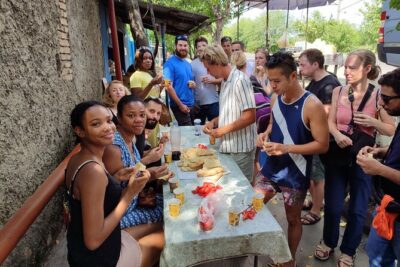
Day Trip to Kakheti Wine Region Including 9 Wine Tastings
Read our review →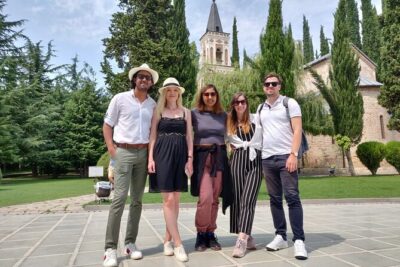
Kakheti Wine Region: Signagi and Bodbe Tour with 10 Wine Tastings
Read our review →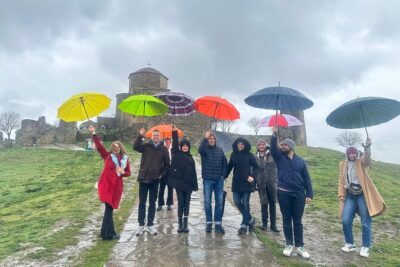
Mtskheta,Jvari,Bazaar,wine tasting,Chronicles of Georgia
Read our review →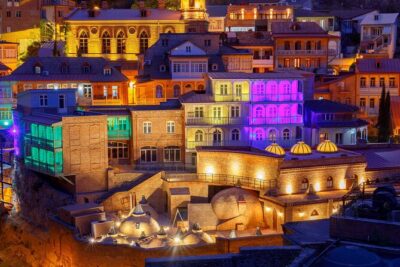
Evening Walking & Talking Tour with Wine & Boat Ride
Read our review →
Kakheti;City of Love Sighnaghi, Bodbe. KTW. Wine House Group tour
Read our review →
Bodbe, Sighnaghi, Telavi Wine Tour from Tbilisi
Read our review →
Old Tbilisi Highlights walking tour with wine & 10 tastings
Read our review →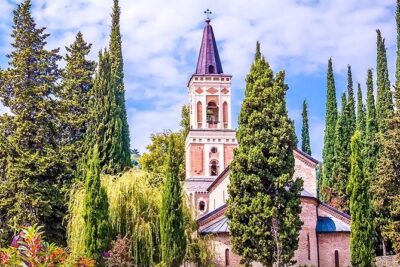
Browse the lists this tour appears in