
Reviewed · MTSKHETA TOURS
Ancient Georgia Group Tour: Mtskheta,Jvari, Gori, Uplistsikhe
Georgia packs an astonishing range of history into one long day. You’ll look over the meeting point of two rivers at Jvari, enter the country’s most important cathedral in Mtskheta, confront Stalin’s complicated legacy in Gori, and scramble through an ancient cave town at Uplistsikhe. I especially like the variety of the stops and the way the route links religious, political, and archaeological Georgia.
I also like the small-group format, with a maximum of 15 people, and the guides’ strong personal touch. Guides named David, Natalia, Omar, Tami, and Lasha are praised for clear explanations, patience, and good group management. The main catch is the length: nine to ten hours is normal, and a bilingual departure may stretch to 11 hours.
Key points to know before you book
- Four very different historic sites: You see a hilltop monastery, a major cathedral, a Stalin museum, and a rock-cut settlement in one outing.
- Uplistsikhe requires careful footing: The cave town has uneven rock paths, climbing, and exposed sections that can be difficult in wet weather or for anyone with mobility limits.
- Entry fees are extra: Budget 15 GEL for the Stalin Museum and 15 GEL for Uplistsikhe, in addition to the tour price.
- Lunch is not included: The day stops at a local restaurant, but you pay for food and drinks yourself.
- Church dress rules matter: Women may want a head scarf, while men should wear long trousers or bring a covering for their legs.
- Bilingual tours can take longer: English may be paired with Russian, so confirm the language arrangement if timing matters.
Why this route works so well in one day
At $24 per person, this is a remarkably inexpensive way to reach several important places outside Tbilisi. The price covers transport in an air-conditioned vehicle, onboard WiFi, and a guide. You still pay the two admission fees and your own lunch, but the basic cost remains low for a full day away from the capital.
The route also has a useful rhythm. Jvari gives you a short scenic and religious introduction. Gori shifts the mood toward modern political history. Uplistsikhe brings you into a physical archaeological site where you walk, climb, and look closely at the stone. Mtskheta closes the day with Georgia’s central Christian story.
You should think of this as an efficient overview rather than a slow, specialist tour. Each main stop gets enough time to understand and explore it, but you will not have hours for side streets, extended museum study, or a leisurely meal. That tradeoff is fair at this price, especially if you have only a few days in Georgia.
More Gori and Uplistsikhe trips:
- Day Trip to Mtskheta Gori and Uplistsikhe
★ 5.0 · 1,801 reviews - Mtskheta-Gori-Uplistsikhe
★ 5.0 · 112 reviews - Mtskheta, Jvari, gori, uflistsikhe, history and panorama (group tours)
★ 4.5 · 107 reviews
Jvari Monastery above two rivers
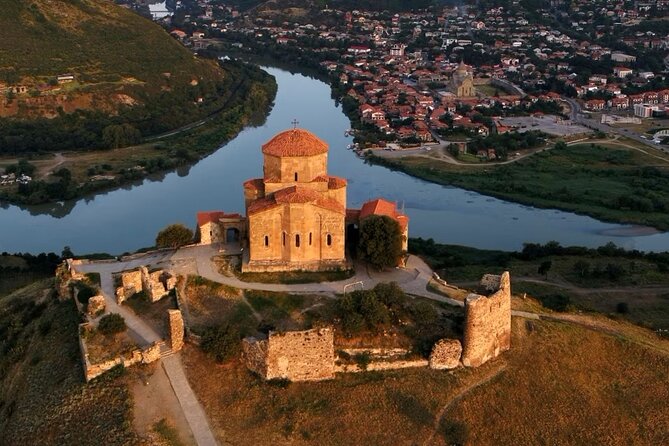
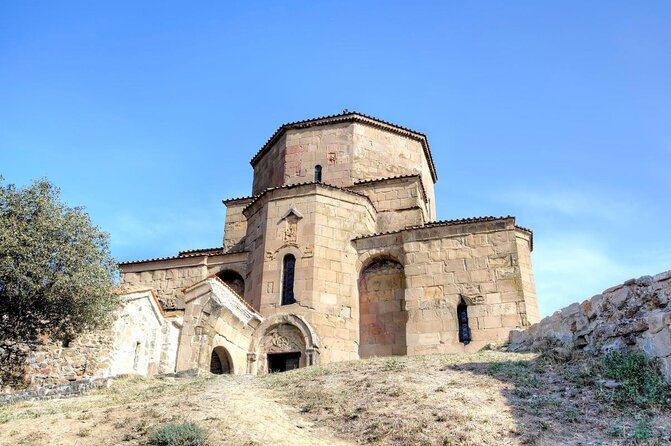
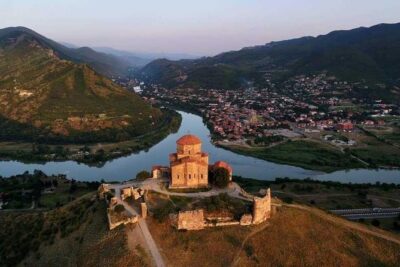
The first stop is Jvari Monastery, perched above the meeting point of the Mtkvari and Aragvi rivers. The setting is one of the day’s strongest visual moments. From the high position, you get a wide view across the water and the surrounding countryside, with the monastery’s simple stone form anchoring the scene.
You have about 40 minutes here, and admission is free. That is enough for the main view, a look inside, and a short explanation from your guide. It is not enough for a long walk around the area, so use your time well and keep your camera ready.
Jvari is also a good first stop because it introduces the role of Christianity in Georgian culture without demanding too much energy at the beginning of the day. The building feels spare and old, and the setting does much of the talking.
Church etiquette applies here. Women may be expected to cover their heads, and men may need long trousers or a leg covering. Scarves are available at church sites, but bringing your own is simpler, particularly if you prefer not to rely on shared coverings.
Svetitskhoveli Cathedral in Mtskheta
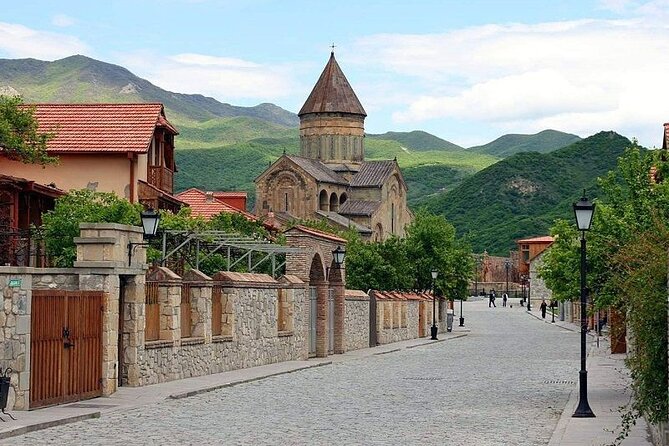
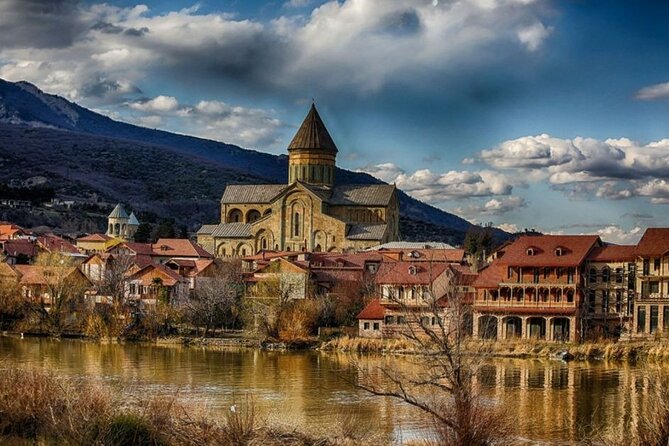
Svetitskhoveli Cathedral sits in the center of Old Mtskheta and gives the day its most important religious stop. Mtskheta was a major center of early Georgian Christianity, and this cathedral is tied closely to the country’s conversion to the faith.
The cathedral is associated with Saint Nino, who is said to have chosen the site. Inside, you may hear about several revered objects, including what is believed to be Christ’s Mantle, a fourth-century baptismal font, and cedar wood connected with the earlier church on the site.
You get about 30 minutes here, with free admission. That is a short visit for a building with this much religious meaning, so listen carefully during the guide’s introduction before looking around on your own. The explanations from guides such as David, Lasha, and Tami are especially useful here because the importance of the cathedral is not obvious from its stone walls alone.
The cathedral is also a reminder that this is an active place of worship, not simply an archaeological exhibit. Dress modestly and follow local instructions. The itinerary places Mtskheta later in the day, after Gori and Uplistsikhe, so you may find the visit calmer as a closing stop than it would be during a busy morning.
Gori and the Stalin Museum
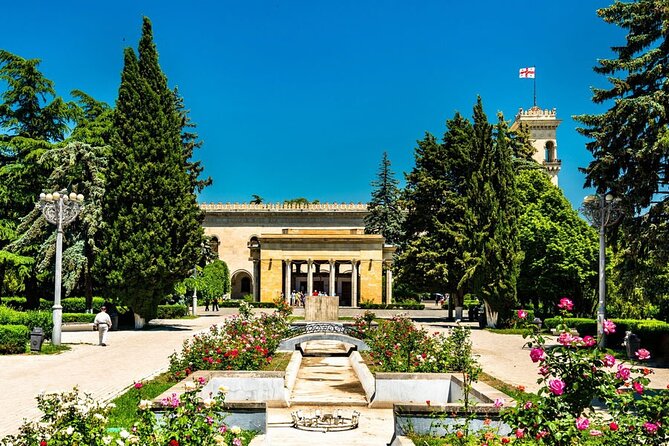
Gori is the birthplace of Joseph Stalin, and the State Stalin Museum presents the town’s most famous and difficult connection. The museum complex opened in 1957. Stalin’s birth house became a memorial museum in 1937, while he was still alive.
You have about an hour here, and admission costs 15 GEL per person. The fee is not included in the tour, so keep some Georgian currency available. The museum focuses on Stalin’s life and public image, making this a very different experience from the churches and ancient ruins elsewhere on the route.
The stop can be fascinating, but it is not emotionally neutral. You are looking at a museum shaped by the Soviet period and by the memory of a leader responsible for immense suffering. The presentation may feel more commemorative than critical, depending on what you expect from the visit. Go in ready to think about both the historical importance of the site and the limits of its interpretation.
One practical limitation is that the museum does not provide an audio-headset option, so your guide’s explanation matters. Guides who have handled this stop well add context that the displays may not supply on their own. The hour gives you a useful introduction, though anyone wanting to study every exhibit will probably want more time.
More Mtskheta and Jvari trips:
- Tbilisi:Mtskheta,Jvari,Bazaar,wine tasting,Chronicles of Georgia
★ 5.0 · 730 reviews - Mtskheta-Jvari-Uplistsike-Chronicle of Georgia, PRIVATE Trip
★ 5.0 · 105 reviews - Tbilisi – Mtskheta – Jvari. Full City Tour on Hop On Hop Off Bus
★ 4.5 · 91 reviews - Ancient Mtskheta and Chronicle of Georgia half day tour
★ 5.0 · 66 reviews
Uplistsikhe, Georgia’s rock-cut town
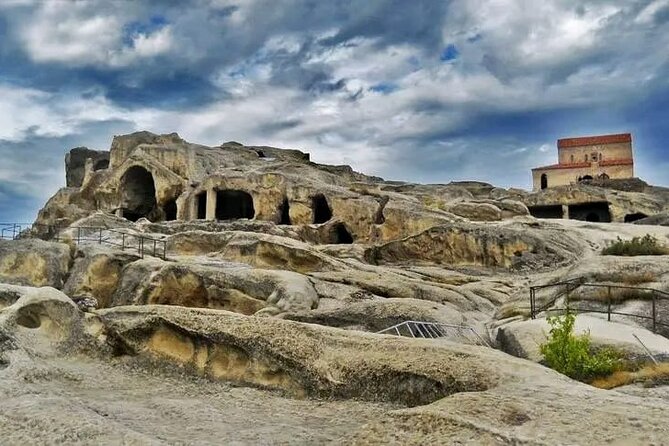
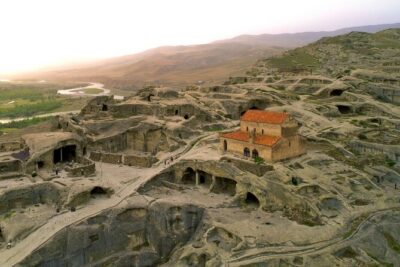
Uplistsikhe is the physical highlight of the day. Built into a high rocky bank beside the Mtkvari River, the settlement contains structures from the Early Iron Age through the Late Middle Ages. Its unusual character comes from the way rock-cut spaces sit beside both pagan and Christian buildings.
You get about an hour at the site, with a separate lunch stop at a local restaurant. Admission to Uplistsikhe costs 15 GEL and is not included. The visit is not a flat walk through tidy ruins. You move across exposed rock, pass through carved chambers, and climb uneven surfaces while trying to picture how the settlement functioned over many centuries.
Wear shoes with good traction. Wet rock can be treacherous, and the site is not a good match for anyone with serious mobility limitations. This is the one stop where fitness and balance affect how much you can see. If you are comfortable walking over rough ground, the setting rewards you with unusual views into the carved rooms and across the river valley.
The time allocation gives you a strong introduction, but it does not allow for every corner. Follow your guide at the start, then use your free moments to look at the details: doorways cut into stone, open-air passages, and the contrast between pagan spaces and later Christian structures. This is where the tour feels most hands-on.
Lunch, transport, and the shape of the day
Lunch is taken at a local restaurant, but food and drinks are your responsibility. That arrangement keeps the tour price low and gives you some choice, though a long day means you should not assume lunch will be a leisurely break. Carry water and a small amount of cash for extras.
Transport time is already included in the nine to ten-hour total. The day starts at 9:00 a.m. at 15 Abano Street in Tbilisi and returns to the same meeting point. The air-conditioned vehicle and onboard WiFi are useful comforts because you spend a fair amount of the day on the road.
The maximum group size is 15, which is small enough for a guide to keep track of people at the sites. One of the strongest practical benefits is group management. David, for example, is praised for keeping everyone together and adjusting smoothly between English and Russian. Natalia is noted for careful explanations and clear instructions, while Omar is described as friendly and attentive.
Still, do not assume every departure will operate in only English. At least one English booking became a dual-language tour, with the guide repeating explanations in Russian. That can add several hours. If your day needs to finish on a strict schedule, ask about the language mix before setting out.
What the guides add to the experience
This route depends heavily on the guide. Jvari and Svetitskhoveli can be appreciated on your own, but their religious importance is easier to grasp with context. Gori needs careful explanation, and Uplistsikhe becomes much more interesting when someone points out how its pagan and Christian elements fit together.
The strongest guide feedback centers on history, communication, patience, and group care. David is described as comfortable in several languages and able to keep a mixed group engaged. Omar is praised for friendliness, while Tami is noted for answering questions and staying attentive. Lasha is described as patient and genuinely warm, and Diana is praised for explaining Georgian customs and setting the scene before each stop.
There is one caution: guiding style can vary. One account describes a guide who became impatient late in the day and did not always walk the whole group through each site. That matters because the tour works best when the explanations are given at the ruins, not only from the vehicle or at the entrance.
Is the $24 price good value?
Yes, provided you understand what the price leaves out. You pay $24 for transport, WiFi, an air-conditioned vehicle, and guided access to a full day of major sites. Add 30 GEL for the two listed admissions, plus lunch and drinks, and the final cost is still modest for the amount of ground covered.
The value is strongest for a first visit to Georgia. You get a broad look at religion, archaeology, Soviet history, and the countryside without arranging several separate trips. It is less suitable if you want a slow, museum-heavy day or a private guide who can change the schedule around your interests.
The 4.7 rating from 73 ratings and 93 percent recommendation rate fit the tour’s strengths: strong site selection, good guides, comfortable transport, and a price that makes the long day easy to justify. The main risks are the long duration, possible bilingual narration, extra fees, and the rough footing at Uplistsikhe.
Should you book this Ancient Georgia day tour?
Book it if you want a broad, affordable introduction to the historic area around Tbilisi and you are comfortable spending most of the day on a structured schedule. It is particularly good for first-time visitors who want to see major religious sites, Stalin’s birthplace, and Uplistsikhe without hiring a private car.
Skip it if you have mobility limitations, dislike uneven ground, need a guaranteed English-only tour, or prefer to spend half a day at one archaeological site. For most active visitors, though, this is a smart use of one day. Bring sturdy shoes, modest clothing, lunch money, and patience for the road. You will come away with a clear sense of how varied Georgia’s past can be.
FAQ
How long does the tour last?
The planned duration is approximately nine to ten hours, including transportation. A bilingual departure may take longer, with one reported English and Russian tour lasting about 11 hours.
What time does the tour start?
The tour starts at 9:00 a.m.
Where does the tour begin and end?
It begins at 15 Abano Street in Tbilisi and ends back at the same meeting point.
Is the tour offered in English?
English is offered. The tour may also operate in more than one language, so English explanations could be repeated in Russian.
What is included in the price?
The price includes an air-conditioned vehicle and WiFi on board. Guided visits to the listed sites are part of the experience.
Is lunch included?
No. The tour visits a local restaurant, but food and drinks are paid for separately.
How much are the admission fees?
The Stalin Museum admission is 15 GEL per person. Uplistsikhe admission is also 15 GEL per person.
Is the tour suitable for people with mobility issues?
Uplistsikhe involves climbing over uneven rock and can be difficult for people with mobility limitations. Wet weather can also make the surfaces hazardous.
What should I wear for the churches?
Women may want to bring a scarf to cover their heads. Men should wear long trousers or bring a covering for their legs.
How many people can join the tour?
The maximum group size is 15 people.
Can I cancel for a full refund?
You can cancel at least 24 hours before the start time for a full refund. Cancellations or changes made less than 24 hours before departure are not refunded or accepted. Poor weather or failure to reach the minimum group size may result in another date, another experience, or a full refund.
Just added around Tbilisi
- Old tbilisi walking tour & wine tasting★ 5.0 · 9 reviews
- Tbilisi Airport to Gudauri, Bakuriani, Batumi, Tbilisi★ 5.0 · 3 reviews
- Private Adorable City Tour of Tbilisi★ 5.0 · 3 reviews
- Vardzia. Lake Paravani, Khertvisi & Lomisa castle, Rabati★ 4.5 · 12 reviews
- full day Kazbegi-Gudauri-jvari -from Tbilisi★ 5.0 · 6 reviews
- Your unique photo session in Tblisi, Georgia★ 3.5 · 4 reviews
- Private Wine Tour In Kakheti Region with 7 Wines and Lunch★ 5.0 · 3 reviews
- Wine promenade in hospitable Tbilisi★ 5.0 · 17 reviews
Mtskheta Tours, compared.
Mtskheta,Jvari,Bazaar,wine tasting,Chronicles of Georgia
Read our review →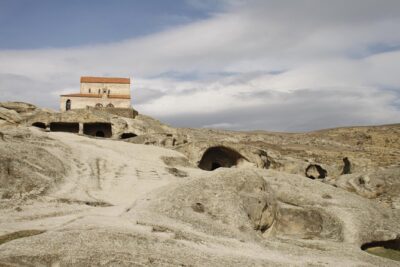
Mtskheta, Jvari, gori, uflistsikhe, history and panorama (group tours)
Read our review →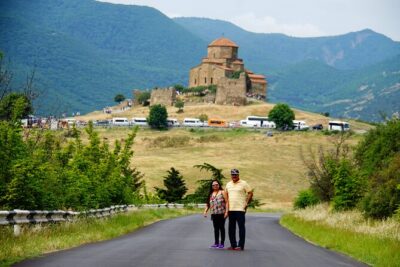
Jvari-Uplistsike-Chronicle of Georgia, PRIVATE Trip
Read our review →
Mtskheta – Jvari. Full City Tour on Hop On Hop Off Bus
Read our review →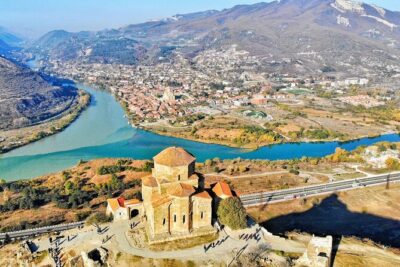
Ancient Mtskheta and Chronicle of Georgia half day tour
Read our review →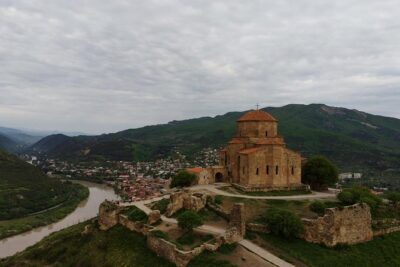
Private Day Trip to Gudauri and Kazbegi from Tbilisi via Jvari and Mtskheta
Read our review →Browse the lists this tour appears in