
Reviewed · WALKING TOURS
Walking Tour Tbilisi: From the USSR to the 1st Female President
Georgia’s modern political story is written across a compact stretch of central Tbilisi. This private walk connects Parliament, the April 9 memorial area, the Presidential Palace, and the House of Justice, turning familiar city sights into an introduction to the country’s road from Soviet rule to independent government. Guide Irakli leads the walk in English and leaves time for questions.
I like the efficient route and the focus on events that still shape Georgia today. I also like that the tour stays small and private, so you can ask about politics, law, and daily life without trying to speak over a busload of people. The main drawback is its short length: you will see the buildings from outside, and this is an orientation to Georgian politics rather than a full city tour.
Key points to know before booking
- A 45-minute to one-hour route: The walk covers a small central area, so it fits easily into a busy Tbilisi schedule.
- A modern-history focus: Expect discussion of the Soviet period, the April 9, 1989 events, presidential power, and Georgia’s legal system.
- Four meaningful locations: The route links Parliament, the scenic park connected with April 9, the Presidential Palace, and the House of Justice.
- Irakli as your guide: He leads the English-language walk and makes room for questions and discussion.
- Outdoor sightseeing only: You do not enter the Parliament, Presidential Palace, or House of Justice.
- A private experience: Only your group takes part, with mobile tickets and free cancellation up to 24 hours before the start time.
Why this short Tbilisi walk is worth your time
Many first visits to Tbilisi focus on churches, balconies, sulfur baths, and hilltop views. Those sights matter, but they do not fully explain the country you are seeing. Georgia’s recent political story helps make sense of the flags, public buildings, memorials, and strong sense of national identity you encounter around the city.
This tour takes that story seriously without asking you to spend half a day on it. In less than an hour, you move through several sites tied to Georgian democracy and government. The route is particularly useful early in your stay, when you want context before exploring the rest of the capital.
I like the balance between walking and conversation. You are not simply being led from one photo stop to another. At each location, Irakli explains why the place matters, then you can ask about the political changes that followed the end of Soviet rule. The short route also keeps the discussion focused.
The private format makes a real difference here. Politics can bring up complicated questions, and a small group gives you room to ask for clarification. If you are traveling with family or friends, you can shape the conversation around your own interests instead of following a fixed script designed for a large crowd.
Still, keep your expectations in check. This is not a complete history of Georgia, an architecture tour, or an inside visit to government buildings. You will not spend long periods at each stop, and the experience depends on your interest in political history. If you prefer markets, food, or old-town stories, another walking tour may suit you better.
More walking tours in Tbilisi:
- Tbilisi Walking Tour Including Cable Car and Traditional Bakery
★ 5.0 · 1,310 reviews - Tbilisi:Evening Walking & Talking Tour with Wine & Boat Ride
★ 5.0 · 572 reviews - Old Tbilisi Highlights walking tour with wine & 10 tastings
★ 5.0 · 276 reviews
Starting at Parliament on Rustaveli Avenue
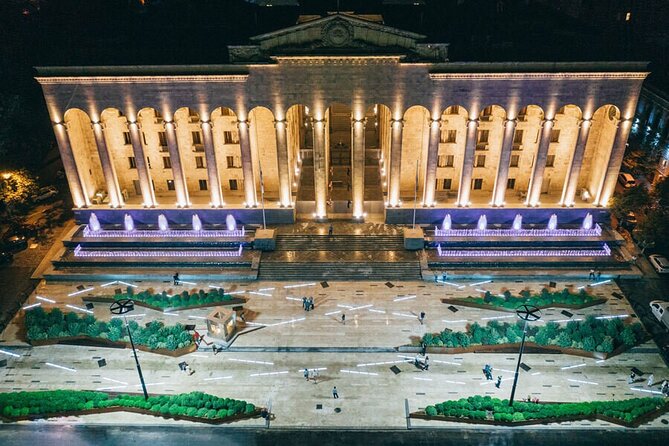
The tour begins in front of the Parliament of Georgia at 8 Shota Rustaveli Avenue. That starting point gives the walk an immediate sense of purpose. Parliament is not just a grand civic building to photograph. It is the natural place to begin a conversation about Georgian democracy and the country’s efforts to define its own political direction.
From here, Irakli sets the basic timeline. The discussion covers the Soviet period and the developments that followed the collapse of the Soviet Union. The supplied tour details do not promise a fixed lecture or a particular sequence of political events, so you should expect the conversation to respond to your questions.
That flexibility is useful if you want more than dates and names. You might ask how Georgia’s political structure works, why certain government buildings matter, or how changes in leadership affected the country. The experience is designed to give you a working framework rather than overwhelm you with every detail.
The location is also practical. Parliament sits on a central avenue, and the walk proceeds through central Tbilisi rather than sending you far across the city. Since the whole activity lasts about 45 minutes to one hour, you can pair it with other sightseeing before or after.
You should arrive ready to walk at a moderate pace. The tour requires a moderate level of physical fitness, but no demanding hike is described. Comfortable shoes remain a sensible choice for any city walk, especially one that moves between several public sites.
Remembering April 9, 1989 in the park
A scenic park along the route provides the setting for the section on April 9, 1989. This is one of the most important parts of the experience because it links a peaceful public space with a painful moment in Georgia’s modern past.
The tour explains the events of April 9 and why they matter in the country’s movement away from Soviet control. That date is not treated as a distant chapter. It helps explain the emotional force behind Georgian independence and the public memory attached to the city’s political spaces.
I find this stop especially valuable because it slows the tour down. Parliament and presidential buildings can feel formal and remote. A park connected with a major public event makes the history easier to picture. You can stand in the same general setting while listening to the account, rather than trying to absorb the subject in a museum room or from a printed timeline.
The details supplied for the tour do not specify a formal museum display, indoor exhibit, or named memorial structure at this stop. You should therefore expect an outdoor explanation from the guide, not an extended visit inside an interpretation center.
That distinction matters. The stop gives you context, but it will not provide every document, image, or political viewpoint connected with April 9. If you want a full study of the period, you will need other sources. For a short city walk, though, this is a strong way to understand why independence and public memory remain so important in Georgia.
Seeing the Presidential Palace and the first female president
The Presidential Palace is the next major focus. You do not go inside, but the exterior gives the guide a way to explain Georgia’s presidency and an unusual feature of the capital: Georgia has two presidential palaces.
That detail alone makes the stop more interesting than a standard government-building photo opportunity. Irakli explains why both palaces exist and why Georgia’s first female president moved to Orbeliani Palace in 2018. The point is not simply to identify a building. It is to show how political institutions, official residences, and leadership can change over time.
For you, this is a useful lesson in reading a city. A palace may look like a static monument, but its role can shift with the officeholder and the needs of government. The tour uses that change to explain a current chapter in Georgia’s political life.
The experience does not include entry to the palace, so do not book it expecting grand interiors or a security-area visit. The value comes from the explanation outside and from the connection between the building and the presidency.
This stop also works well for people who want to understand Georgia beyond its older churches and fortresses. The country’s identity is not only medieval or traditional. Its recent political decisions are visible in the places where leaders work and live.
More days out of Tbilisi:
- Day Trip to Kakheti Wine Region Including 9 Wine Tastings
★ 5.0 · 2,774 reviews - Highlights of Caucasus Mountains-Jinvali,Ananuri,Gudauri,Kazbegi(Group tour)
★ 5.0 · 2,682 reviews - Day Trip to Kazbegi and Gudauri
★ 5.0 · 2,009 reviews - Day Trip to Mtskheta Gori and Uplistsikhe
★ 5.0 · 1,801 reviews
Finishing at the House of Justice
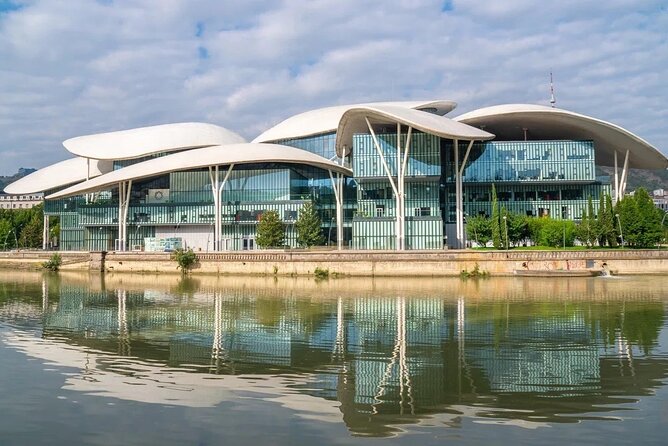
The walk ends at the House of Justice on Zviad Gamsakhurdia Named Right Bank. This modern public building provides a useful change of mood after the memorial and presidential stops. Here, the conversation turns toward Georgia’s legal system and its role in shaping the country’s present political reality.
The tour does not promise an interior visit, and the supplied details say the route ends at the House of Justice. You should expect to learn about the institution from the outside rather than receive a guided tour of its services or offices.
That ending makes sense. The route begins with Parliament, moves through a key public memory site, examines the presidency, and finishes with law and public administration. It gives the walk a clear progression from political power and historical change toward the systems that affect citizens today.
The House of Justice is also a useful final reference point for the rest of your visit. After the tour, you have a better basis for asking how Georgia’s government operates and how its legal system fits into daily life. The experience does not claim to answer every legal question, but it gives you the vocabulary to understand later conversations and sightseeing.
Because the endpoint is on the right bank, check your plans for the rest of the day before booking. The meeting and ending locations are different, which is convenient if you want to continue exploring rather than return to Parliament.
How Irakli’s guiding style shapes the experience
Irakli is described as attentive, flexible, and a strong storyteller. Those qualities matter more here than a long list of dates. Political history can become dry when it is delivered as a lecture, especially during a short walk with several stops.
The tour is built around questions as much as prepared information. You can ask for more detail about the fall of the Soviet Union, the presidency, Georgian culture, or the country’s legal structure. That makes the same route work for a first-time visitor who wants basic context and for a politically curious visitor who wants a more detailed exchange.
The English-language format is helpful if you want to discuss ideas rather than simply follow directions. One piece of feedback also came through an auto-translated Russian comment, suggesting that the guide’s communication can work across language backgrounds, but the advertised language for this activity is English.
I would book this with the expectation of a conversation, not a theatrical performance. You will get the most from it if you arrive with a few questions. For example, you might ask why Georgia has two presidential palaces, what changed after 1989, or how the House of Justice fits into public life.
Timing, walking effort, and group size
The stated duration is approximately 45 minutes to one hour. That is long enough to cover the main points but short enough to fit before lunch, after breakfast, or between larger sightseeing plans.
The compact timing is one of the tour’s strengths. You do not lose a morning to a subject you may only want to sample. At the same time, the short format limits how much detail the guide can provide. If your main goal is a full account of Georgian political history, you may find the hour goes quickly.
This is a private activity, so only your group participates. That gives you control over the pace and lets you ask questions without waiting for a large crowd. It also means the quality of the experience rests heavily on the conversation between you and Irakli.
The route requires moderate physical fitness. The supplied information does not give a precise distance, number of stairs, or detailed surface conditions. If you have mobility concerns, ask for clarification before booking. Service animals are allowed, and the start and end points are near public transportation.
The tour operates outdoors and requires good weather. If poor weather causes cancellation, you are offered a different date or a full refund. That policy is useful, but it also means you should avoid placing an unmovable appointment immediately afterward if the forecast looks uncertain.
What the tour includes, and what it does not
The experience includes an English-language private walk, a mobile ticket, and explanations at the main political sites. It does not include entry to Parliament, the Presidential Palace, or the House of Justice.
That outdoor-only format keeps the tour quick and easy to schedule. You are paying for the guide’s interpretation and the private exchange, not for admission tickets or access to restricted interiors. The value is strongest if you want context that you can carry into the rest of your time in Tbilisi.
Because no price is provided here, I cannot judge the exact cost against other tours. I would measure the value by your interest in the subject. For someone curious about Georgian politics, an hour with a guide who can answer questions may be a smart use of time. For someone seeking a broad introduction to food, architecture, or old Tbilisi, the same fee might be better spent elsewhere.
The five available ratings are all at the top level, and the strongest praise centers on the same points: the clear political context, the guide’s attentiveness, the useful amount of information in a short time, and the chance to ask questions. Those are the features to prioritize when deciding.
Who should book this Tbilisi experience
I would recommend it to you if you want to understand the country’s recent past rather than simply photograph its historic buildings. It is a good match for visitors interested in democracy, public institutions, the end of Soviet rule, or the role of political leadership in modern Georgia.
It also suits anyone with a tight schedule. The route gives you a focused introduction in about an hour, then leaves the rest of your day free. The private format makes it especially practical for couples, families, or friends who want to set their own questions.
You may want another tour if this is your first-ever orientation to Tbilisi and you mainly need help with the old town, food, churches, or city views. You should also skip it if you expect to go inside government buildings or spend hours examining exhibits.
Should you book the walk?
Book this tour if you want the political key to Tbilisi. In a short route from Parliament to the House of Justice, Irakli connects Soviet history, the April 9 events, the presidency, Georgia’s first female president, and the modern legal system.
I especially like it as an early-trip activity. It gives you a framework for seeing the city with sharper eyes, and the private format lets you ask the questions that a standard sightseeing route may avoid. Just remember that the tour is brief, outdoors, and focused on explanation rather than access to interiors.
Free cancellation is available up to 24 hours before the start time. Within 24 hours, the amount paid is not refunded, and changes are not accepted. If bad weather cancels the activity, you can choose another date or receive a full refund.
FAQ
Where does the tour begin?
It begins in front of the Parliament of Georgia at 8 Shota Rustaveli Avenue, Tbilisi.
Where does the tour end?
The tour ends at the House of Justice, located at 1 Zviad Gamsakhurdia Named Right Bank, Tbilisi.
How long does the walking tour last?
The tour lasts approximately 45 minutes to one hour.
Is the tour offered in English?
Yes. English is the listed language for the activity.
Is this a private tour?
Yes. Only your group participates in the activity.
Do you enter the government buildings?
No. The tour visits the areas around Parliament, the Presidential Palace, and the House of Justice, but you do not go inside the buildings.
What will I learn at the park?
The park stop focuses on the events of April 9, 1989.
Why does the tour visit the Presidential Palace?
The guide explains why Georgia has two presidential palaces and why the country’s first female president moved to Orbeliani Palace in 2018.
Is the tour suitable for people with limited mobility?
The activity requires a moderate level of physical fitness. Specific information about distance, stairs, and surfaces is not provided, so you should request more details before booking if needed.
Can I cancel for a full refund?
Yes, if you cancel at least 24 hours before the experience’s start time. Cancellations within 24 hours are not refunded, and changes within that period are not accepted.
Just added around Tbilisi
- Old tbilisi walking tour & wine tasting★ 5.0 · 9 reviews
- Tbilisi Airport to Gudauri, Bakuriani, Batumi, Tbilisi★ 5.0 · 3 reviews
- Private Adorable City Tour of Tbilisi★ 5.0 · 3 reviews
- Vardzia. Lake Paravani, Khertvisi & Lomisa castle, Rabati★ 4.5 · 12 reviews
- full day Kazbegi-Gudauri-jvari -from Tbilisi★ 5.0 · 6 reviews
- Private Wine Tour In Kakheti Region with 7 Wines and Lunch★ 5.0 · 3 reviews
- Wine promenade in hospitable Tbilisi★ 5.0 · 17 reviews
- Your unique photo session in Tblisi, Georgia★ 3.5 · 4 reviews
Walking Tours, compared.
Tbilisi Walking Tour Including Cable Car and Traditional Bakery
Read our review →
Evening Walking & Talking Tour with Wine & Boat Ride
Read our review →
Old Tbilisi Highlights walking tour with wine & 10 tastings
Read our review →
Old Tbilisi Tour: Private Walking Tour With Wine Tasting
Read our review →
Private Tbilisi Food Tour: 9 Tastings Walk in Bohemian District
Read our review →
Tbilisi Old Town Walking Tour with a Local Guide
Read our review →
Discover Tbilisi: Hidden Gems and Iconic Sights Walking Tour
Read our review →
Browse the lists this tour appears in