

Reviewed · SOVIET ERA TOURS
Soviet Tbilisi Tour – Off the beaten path
Tbilisi’s Soviet past is easiest to understand away from the postcard center. This five-hour tour takes you into a basement printing house linked to Stalin, up to the huge Chronicles of Georgia monument, and through concrete housing districts connected by a rusty skybridge. It is history, urban exploration, and oddball architecture in one outing.
I like the small private-group format, which gives you room to ask questions and stop for photographs. I also like the way the route connects politics, daily life, monumental art, and city planning instead of treating Soviet Tbilisi as a single museum subject. The main consideration is that some sites are rough, unfinished, or decaying, so this is not a polished sightseeing circuit.
What makes this Tbilisi tour different
- Stalin’s underground printing house: Enter a basement museum inside an old private home, with Soviet relics and a memorable meeting with its dedicated communist director.
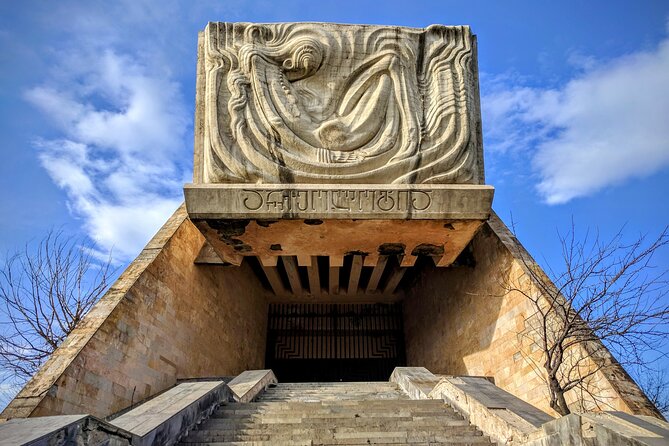
- Chronicles of Georgia: See Tsereteli’s enormous hilltop monument, often called Georgia’s Stonehenge, with views toward Soviet apartment blocks and Tbilisi Sea.
- Nutsubidze Skybridge: Walk through one of Tbilisi’s strangest housing connections, built to help people move between steep residential districts.
- Private attention: Your group travels alone, so guides such as George, David, Temo, Zezva, or Irakli can adjust the discussion to your questions.
- A useful city overview: The route reaches places that are awkward to visit independently, including outer districts and large Soviet building projects.
- Good value at $49.68: For roughly five hours of private guiding, transport, and included admission at the printing house, the price is fair.
Why Soviet Tbilisi is worth your afternoon
Most first visits to Tbilisi concentrate on the old town, sulfur baths, churches, balconies, and riverfront streets. Those sights matter, but they show only one layer of the city.
This tour shifts your attention to the 20th century. You see how Soviet power used secret printing networks, monumental sculpture, apartment construction, and giant public buildings to shape Georgian life. The result is not a tidy history lesson. It is a series of places that feel strange, practical, grand, and sometimes slightly absurd.
I especially like the balance between formal sites and ordinary residential areas. The Chronicles of Georgia gives you a huge symbolic monument, while the Nutsubidze district shows how people actually moved through the concrete city. The contrast helps you understand more than a standard museum visit would.
The guides also add a personal element. Names connected with this experience include Temo, Zezva, Irakli, George, and David, though your guide depends on the date. The strongest descriptions point to guides who explain the wider political setting, answer questions about Georgia, and add stories about people connected with the sites. English is offered throughout.
More Soviet era walks around Tbilisi:
- 1 Day Private Armenia: UNESCO, Soviet & Curated Family Lunch
★ 5.0 · 106 reviews - Tbilisi old town & soviet heritage – Private driver-guided Tour
★ 5.0 · 83 reviews - Armenia: 1 Day Soviet gems, UNESCO + Family lunch (Small group)
★ 5.0 · 68 reviews
Inside Stalin’s underground printing house
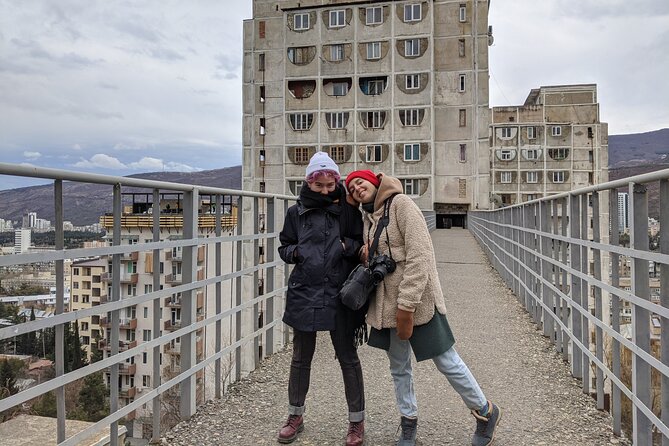
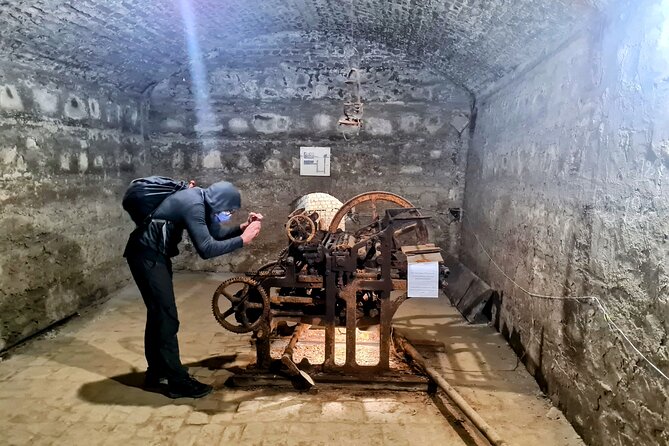
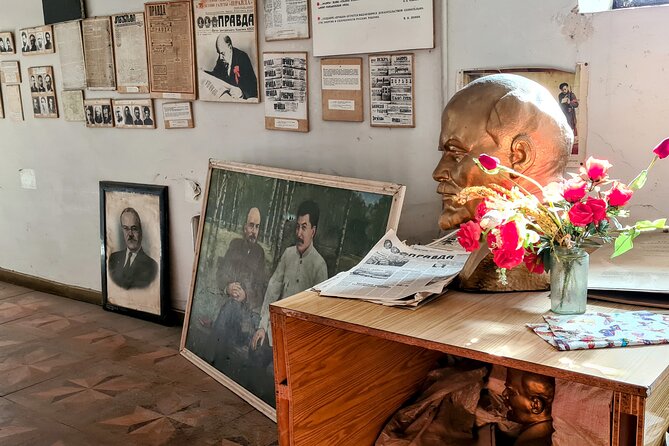
The first major stop is J. Stalin’s Underground Printing House Museum. It occupies the basement of an old private house, which makes the visit feel far removed from a conventional state museum.
You enter a place tied to the production and distribution of communist material. The setting itself does much of the work. A basement printing operation suggests secrecy, risk, and organization in a way that a display case of old documents cannot.
The museum also contains Soviet-era objects and relics. One unusual part of the visit is meeting the museum director, described as a committed communist. That encounter gives the place an unusual human angle. You are not simply looking at the Soviet period from a safe distance. You are hearing it discussed by someone who still feels a strong connection to its ideals.
Allow about 30 minutes here. That is enough time for an introduction, the underground setting, and the main objects without making the first stop feel overlong.
I would come with an open mind. This is not a neutral modern history museum in the usual sense, and the presentation may feel personal or politically one-sided. That is also what makes it memorable. Your guide can help place the museum and Stalin’s role within Georgia’s wider story.
The Chronicles of Georgia above Tbilisi Sea
From the underground museum, the tour moves to a very different setting: the Chronicles of Georgia. This enormous monument by Zurab Tsereteli rises on a hill above Tbilisi’s concrete apartment districts and the reservoir known as Tbilisi Sea.
The monument is sometimes compared with Stonehenge because of its scale and upright stone forms. The comparison is useful, though the subject is specifically Georgian history. Its carved panels and towering columns give the site a grand, unfinished quality.
Plan on about 30 minutes. You will have time to walk around, take photographs, and look across the city. Admission is free, which helps keep the overall tour price reasonable.
The views are a major part of the stop. From the hill, the monument frames a very different Tbilisi: broad blocks of Soviet housing, open ground, and the water reservoir. You begin to see the city as a collection of large planned areas rather than only a maze of old streets.
This is also a good place to notice the tension between Georgian identity and Soviet-era public design. The monument is dedicated to Georgian history, yet its scale and setting recall the grand gestures common to Soviet public art. Your guide’s explanation matters here, because the site can otherwise seem like a giant photo stop without much context.
Bring something suitable for strong sun or wind if needed, since this is an exposed hilltop location. The supplied details do not list a special dress code or equipment requirement, but comfortable shoes are sensible for walking between the monument’s large stone elements.
Concrete districts and the Nutsubidze Skybridge
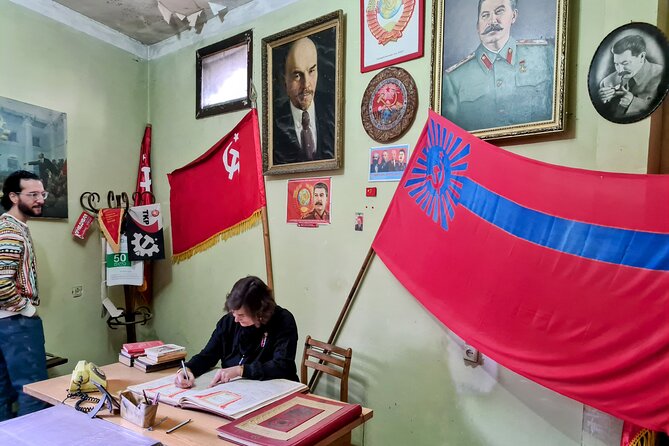
The longest part of the tour is spent around Nutsubidze Skybridge, with about two hours for this area and its unusual buildings. This is where the experience shifts most clearly into urban exploration.
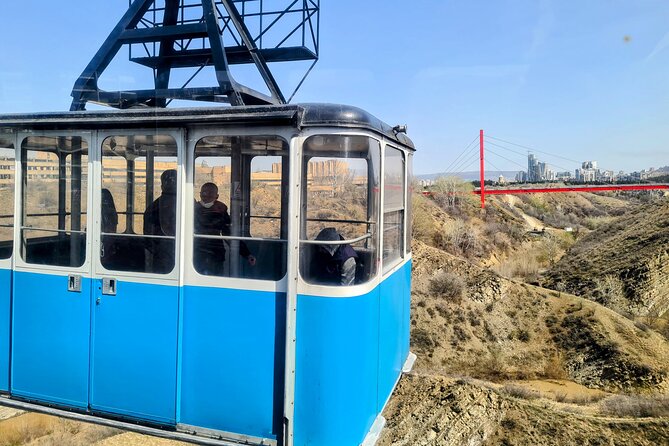
The Nutsubidze district is known for large concrete residential blocks and a Soviet-era connection that helps residents cross between steep housing areas. The skybridge is both practical infrastructure and a striking piece of design. Its weathered condition adds to the atmosphere.
You may see a rusty high-rise gangway between residential towers, along with a Soviet puzzle-like building that seems to ignore ordinary architectural rules. The appeal is not polished beauty. It is the chance to see how engineering, housing, and daily movement were combined in a city built across hills.
The stop also connects with the tour’s wider architectural focus. The route may include the Bank of Georgia building area and a Soviet car museum, depending on the exact schedule and guide. These details appear in descriptions of the experience, but the supplied itinerary formally highlights the skybridge, so you should treat the extra locations as possible additions rather than guaranteed stops.
Two hours gives you much more breathing room than a quick drive-by. You can look closely at surfaces, entrances, passageways, and the relationship between the buildings. You also have time for photographs without being hurried from one viewpoint to the next.
There is a practical tradeoff. Some structures are old, worn, or partly decayed. That will appeal to anyone who likes raw city scenes and unusual photography, but it may disappoint you if you want restored monuments and neat visitor facilities. Keep your attention on where you walk, and follow your guide through the residential areas.
More days out of Tbilisi:
- Day Trip to Kakheti Wine Region Including 9 Wine Tastings
★ 5.0 · 2,774 reviews - Highlights of Caucasus Mountains-Jinvali,Ananuri,Gudauri,Kazbegi(Group tour)
★ 5.0 · 2,682 reviews - Day Trip to Kazbegi and Gudauri
★ 5.0 · 2,009 reviews - Day Trip to Mtskheta Gori and Uplistsikhe
★ 5.0 · 1,801 reviews
A private route that saves you time
The tour is offered as a private activity for your group. That matters in Tbilisi because the stops are scattered across the city, and several are not places you would naturally reach while walking around the old center.
Hotel or apartment pickup is available for private tours when you share your accommodation details. The meeting information also lists the Round Fountain near Avlabari as a starting point, while the stated drop-off is the Dry Bridge flea market on Zviad Gamsakhurdia Right Bank.
That final drop-off is useful. You can continue exploring the flea market rather than losing time returning to your hotel. It also makes the tour a practical way to connect an outer-city excursion with another Tbilisi activity.
The route lasts about five hours. Several descriptions praise the planning of the stops, with limited time spent simply driving and enough time at each location to listen and take pictures. Your exact order may vary, but the basic rhythm is clear: underground history, monumental sculpture, then residential architecture and city infrastructure.
The tour is offered in English, and confirmation is provided at booking. Most people can participate, but no detailed accessibility information is supplied. Since the route includes hills, old structures, and a skybridge, ask the operator about current walking conditions if stairs or uneven surfaces are a concern.
Is $49.68 a fair price?
At $49.68 per person, the price makes the most sense if you value private guiding and transport. You are not paying only for entry to a museum. You are paying for a half-day route across several parts of Tbilisi that would be difficult to organize efficiently on your own.
The printing house includes admission, while the Chronicles of Georgia is free. The main value comes from the guide’s interpretation and from reaching places outside the usual center. The private format also means you can ask about Stalin, Georgian politics, Soviet housing, architecture, or modern Tbilisi without waiting for a large group to move along.
Group discounts may be available, which can improve the price for families or friends booking together. Since the tour is private, the per-person cost is easier to justify when several people share the booking.
I would not choose this tour solely because you want the cheapest way to see monuments. You could visit some sites independently, particularly the free Chronicles of Georgia. But getting to the underground museum, Nutsubidze, and other outer districts while building a sensible route takes time and transport planning. For a visitor with only a few days in Tbilisi, that convenience is significant.
Free cancellation is available up to 24 hours before the start time. If the minimum number of participants is not met and the operator cancels, you are offered another date or experience, or a full refund.
Who will enjoy this offbeat Tbilisi experience?
I would recommend it most strongly if you have an interest in:
- Soviet politics and everyday life
- Brutalist or unusual architecture
- Photography in old residential districts
- Georgia’s modern history
- Places beyond Tbilisi’s old town
- Small private tours with plenty of questions
It is also a good fit if this is not your first day in the city. After seeing the traditional center, you can use this outing to understand the Tbilisi that many short visits miss.
You may want to choose another tour if your priority is medieval churches, food, wine, or the classic old-town sights. This experience is focused on the communist period, architecture, and less polished parts of the city.
I also would not book it expecting a conventional museum program. The most rewarding moments come from the odd settings: a basement printing house, a huge monument on a hill, and a weathered bridge between apartment blocks. The route is curious rather than refined.
Should you book the Soviet Tbilisi Tour?

Yes, if you want to see how Georgia’s Soviet past still appears in its buildings, monuments, museums, and residential districts. The combination of Stalin’s underground printing house, the Chronicles of Georgia, and Nutsubidze Skybridge gives you three very different ways to approach the subject.
The strongest reason to book is the route. You reach places that are hard to fit into an independent visit, and the private guide can connect them into a clear story. Guides such as George, David, Temo, Zezva, and Irakli are associated with warm, engaging explanations and strong command of Georgian history.
Book it knowing that the experience can be rough around the edges. That is part of its appeal. At about five hours and $49.68 per person, it is a solid choice for curious visitors who want Tbilisi beyond the old town and do not mind a little concrete, rust, and political complexity.
FAQ
How long does the Soviet Tbilisi Tour last?
The tour lasts approximately five hours.
What language is the tour offered in?
The tour is offered in English.
Is this a private tour?
Yes. Only your group participates in the private activity.
Is hotel pickup available?
Yes. Pickup is available from your Tbilisi hotel or holiday apartment for private tours. You need to provide your accommodation details.
Where does the tour end?
Drop-off is offered at the Dry Bridge flea market on Zviad Gamsakhurdia Right Bank. The listed end point is 3 Zviad Gamsakhurdia Named Right Bank.
What places are included?
The main listed stops are J. Stalin’s Underground Printing House Museum, the Chronicles of Georgia, and Nutsubidze Skybridge.
Is admission included?
Admission to J. Stalin’s Underground Printing House Museum is included. Entry to the Chronicles of Georgia is free. The tour details do not specify a separate admission charge for Nutsubidze Skybridge.
Can I cancel for a full refund?
Yes. You can cancel at least 24 hours before the local start time for a full refund. Cancellations or changes made less than 24 hours before the start time are not accepted for a refund.
Just added around Tbilisi
- Old tbilisi walking tour & wine tasting★ 5.0 · 9 reviews
- Tbilisi Airport to Gudauri, Bakuriani, Batumi, Tbilisi★ 5.0 · 3 reviews
- Private Adorable City Tour of Tbilisi★ 5.0 · 3 reviews
- full day Kazbegi-Gudauri-jvari -from Tbilisi★ 5.0 · 6 reviews
- Vardzia. Lake Paravani, Khertvisi & Lomisa castle, Rabati★ 4.5 · 12 reviews
- Private Wine Tour In Kakheti Region with 7 Wines and Lunch★ 5.0 · 3 reviews
- Wine promenade in hospitable Tbilisi★ 5.0 · 17 reviews
- Your unique photo session in Tblisi, Georgia★ 3.5 · 4 reviews
Soviet Era Tours, compared.
1 Day Private Armenia: UNESCO, Soviet & Curated Family Lunch
Read our review →
Tbilisi old town & soviet heritage – Private driver-guided Tour
Read our review →
Armenia: 1 Day Soviet gems, UNESCO + Family lunch (Small group)
Read our review →
Brutal Tbilisi: Urban exploration and untold stories
Read our review →
Soviet past – Private day tour to Chiatura, Katskhi pillar and Chronicles
Read our review →
Soviet Story – Private day trip to Chiatura, Stalin’s museum and Katskhi pillar
Read our review →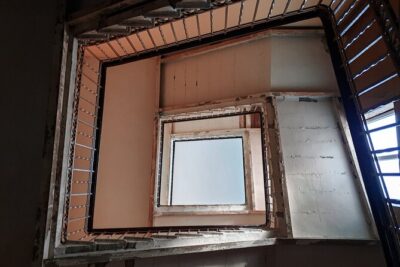
2-Day Kutaisi Tour: Caves, Canyons & Soviet Sanatoriums
Read our review →Browse the lists this tour appears in